
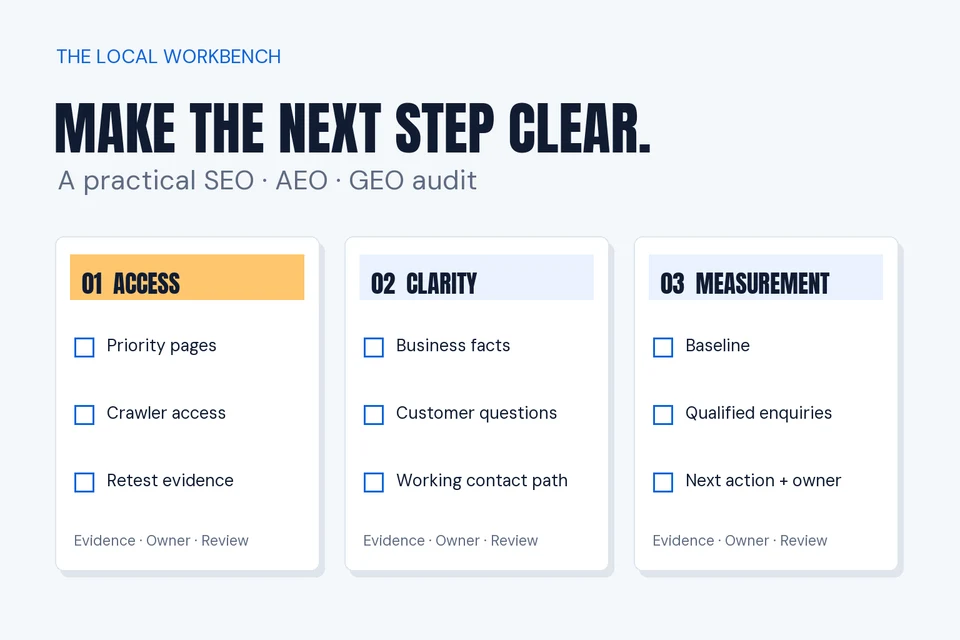
Editorial illustration
Start with a practical audit
A local business can publish useful information and still make it difficult for customers to find the right service, confirm the service area, or request an estimate. Before commissioning another batch of articles, check whether those basic steps work.
SEO, answer engine optimization, and generative engine optimization overlap in practice. For this audit, treat SEO as the broader search foundation, AEO as work that makes customer questions easier to answer, and GEO as work aimed at visibility in generative search experiences. These are working labels, not three independent technical standards.
We believe these steps will improve your chances of appearing in search results and AI answers: they help systems find your website, understand your services, and access useful source material. Use this checklist to turn that work into specific tasks. For each item, record an owner, evidence, and a review date.
Priority 1 Make important pages accessible
Start with the homepage, core service pages, genuine location pages, and contact page.
 Practical checklist
0 of 6 complete
Saved only in this browser when you use the checklist.
Evidence to save: affected URL, inspection result, response status, relevant directive or firewall finding, and the result of the retest.
Google identifies crawler access, a successful HTTP response, and indexable content as basic technical requirements. Check these first so your priority pages are eligible for indexing. Google Search technical requirements
Do not treat robots.txt and noindex as interchangeable. The former manages crawler access; it is not a reliable way to keep a URL out of Google Search. Google must be able to crawl a page to discover its noindex instruction. Google’s robots.txt guide
OpenAI distinguishes OAI-SearchBot, used for search, from GPTBot, which relates to model training. Site owners can make separate decisions about those uses. OpenAI crawler documentation
Priority 1 Correct business facts and contact paths
Create a reference sheet containing the correct business name, contact information, opening hours, services, and service area. Compare the important pages against it.
Practical checklist0 of 6 complete
Saved only in this browser when you use the checklist.
Evidence to save: the approved business reference sheet, corrected URLs, form-test results, and the name of the lead-response owner.
Make every page reflect how the business actually operates. Describe real offices and service coverage accurately, and align forms with the services the team delivers. This helps prospective customers decide whether the business fits their needs.
For a closer profile review, use the Google Business Profile audit.
Priority 2 Resolve questions that determine customer fit
Review recurring customer enquiries using appropriately anonymized information. Look for questions that delay a booking or reveal a mismatch.
Practical checklist0 of 6 complete
Saved only in this browser when you use the checklist.
Evidence to save: the question being addressed, its source, the updated page section, and approval from someone who knows the service.
Write the answer where it helps the visitor make a decision. Avoid turning every paragraph into a keyword-heavy question and answer. If timing depends on parts, access, or permits, describe those dependencies without promising a completion date.
Aim for answers that a customer can act on and a search system can interpret in context: name the service, explain the conditions, and support factual claims with relevant evidence.
Priority 2 Validate structured data against the page
Practical checklist0 of 4 complete
Saved only in this browser when you use the checklist.
Evidence to save: the tested URL, validation result, corrected properties, and retest date.
For applicable businesses, LocalBusiness structured data can communicate details such as hours and departments to Google. Valid markup containing outdated hours is still a business problem. Google’s LocalBusiness documentation
Google says there is no special schema or AI text file required for AI Overviews or AI Mode. Its guidance emphasizes ordinary SEO foundations, accessible text, internal links, and structured data that matches the page. Google’s guidance on AI features
Priority 2 Establish a measurement baseline
Practical checklist0 of 6 complete
Saved only in this browser when you use the checklist.
Evidence to save: reporting dates, filters, metric definitions, conversion definitions, and baseline exports or screenshots.
Keep technical health, visibility, and business outcomes in separate sections. A resolved crawl issue is an implementation result. A linked citation is a visibility observation. A booked customer is a business outcome. None should be substituted for another.
For manual AI checks, save the prompt, date, location context, product used, response, and cited URLs. Separate a brand mention from a linked citation and from an actual visit. Use a consistent prompt sample to track observed changes, and review it alongside referral traffic and customer enquiries.
For repeatable geographic comparisons, use the local-ranking comparison method. If visibility improves but contact does not, follow the enquiry path.
Priority 3 Review changes and decide what comes next
Practical checklist0 of 5 complete
Saved only in this browser when you use the checklist.
Evidence to save: change log, observations, unresolved issues, next action, owner, and review date.
Start with broken access, incorrect business information, and failed contact paths. Next, improve the pages that matter most to qualified enquiries. Expand supporting content only when you can identify the customer question it will answer.
If traffic increases but enquiries remain irrelevant, inspect service clarity and geographic fit before celebrating the increase. A useful SEO, AEO, and GEO audit should leave the business with evidence and a prioritized work list. The outcome to pursue is a clearer path from discovery to a suitable customer enquiry.
Open this guide’s interactive checklist
Sources & editorial note
- Google Search technical requirements
- Google’s robots.txt guide
- OpenAI crawler documentation
- Google’s LocalBusiness documentation
- Google’s guidance on AI features
Sources reviewed by the editorial desk on 1 November 2026.
Found a factual issue? Prepare a correction note through our editorial draft form. It saves on your device; delivery is not yet configured.